How online casinos work
Behind every licensed UK casino lobby sits a stack of regulation, software and independent testing. Here is what actually happens when you press spin.

The operator layer
A licensed operator — Ladbrokes, 10Bet or any brand on our comparison table — runs the website, verifies your age, holds your account and connects you to games. They do not usually build the slots themselves; they license titles from studios like Pragmatic Play, Playtech or Evolution and host them on a shared platform.
Random number generators
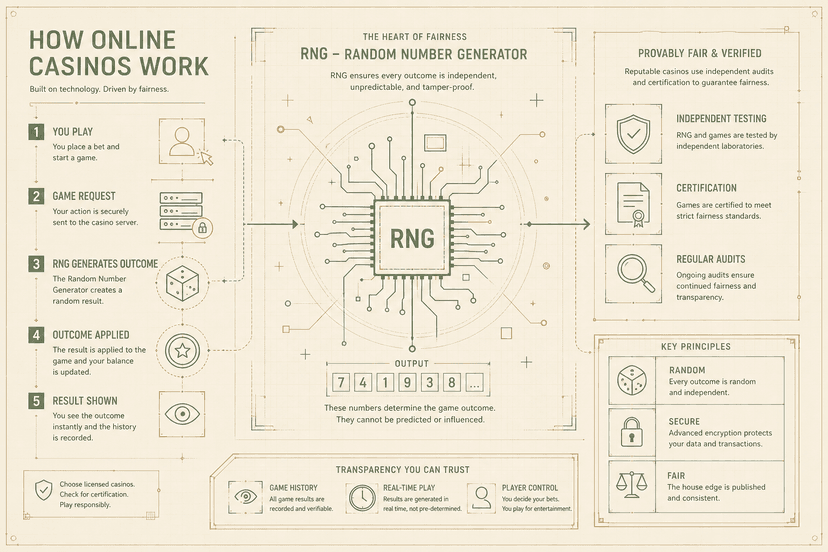
Digital slots and virtual table games use a random number generator (RNG) to determine outcomes. Each spin or hand is independent — past results do not change future odds. The RNG runs on servers audited by testing houses such as eCOGRA or GLI, who check that published return- to-player (RTP) figures match long-run behaviour.
Live dealer games
Live blackjack, roulette and game shows stream from studios with real dealers and physical equipment. Optical character recognition reads cards and wheel positions; the feed is encrypted to your device. The maths still favours the house, but the format removes the abstraction of pure RNG slots for players who prefer it.
UK licensing requirements
The UK Gambling Commission sets conditions on fairness, advertising, anti-money-laundering checks and customer interaction. Operators must segregate player funds, offer self-exclusion and report certain incidents. A licence is permission to trade — ongoing compliance keeps it active.
What we look for in comparisons
When we grade operators on game studios, we are really grading whose tested software you can access and how well the lobby surfaces it. A deeper Evolution suite means more live variants; a Merkur-heavy site leans classic fruit mechanics. Neither is inherently better — but they are different experiences, and that is worth knowing upfront.